

Ready to transform simple moves into big results? This intro shows how a short, regular routine can change your body and boost health. Research cited by the National Library of Medicine and the University of Nebraska found 12 weeks of consistent practice improves lean mass versus fat.
From calves to shoulders, a compact tool engages many areas at once. Brief, steady sessions raise your heart rate fast and build supportive muscle that helps metabolism and balance.
This article breaks down which regions fire during each phase — takeoff, flight, and landing — and gives clear tips on form, gear, and progressions. Expect friendly, practical guidance to protect your back, brace your core, and keep training enjoyable and safe.
Key Takeaways
- Short, consistent sessions can improve body composition in weeks.
- A single tool provides full-body stimulus and quick conditioning.
- Proper form protects joints and boosts long-term strength.
- Simple gear choices make training scalable and enjoyable.
- Focus on rhythm, core bracing, and gradual progress for best results.
Why Jumping Rope Works Your Whole Body Right Now
Short, focused sessions give fast returns. A brief, intense bout raises heart rate quickly and pulls many areas into play at once. The CDC notes vigorous actions like jumping rope can be roughly twice as efficient as moderate activity for improving fitness.
Quick wins: strength, endurance, and calorie burn
Immediate gains come from coordinated force production and an elevated aerobic rate. Studies show a 5-minute jump rope warmup improved time-trial performance over traditional warmups in runners after 10 weeks.
- Recruits key lower- and upper-body groups while spiking cardiovascular demand.
- Builds strength and endurance together, so you get dual benefits in less time.
- Short intervals stack easily into a daily routine for steady progress.
How it compares to other workouts
Compared with steady-state cardio, a rope delivers vigorous intensity fast. That means more effective minutes per session and better neuromuscular control that transfers to running, court play, and everyday movement.
- Portable and time-efficient — ideal when a gym isn’t available.
- Challenges fast-twitch power and timing, so even brief sets feel productive.
- Combines calorie burn during the session with after-effects from high intensity.
Jump Rope Workout Muscles
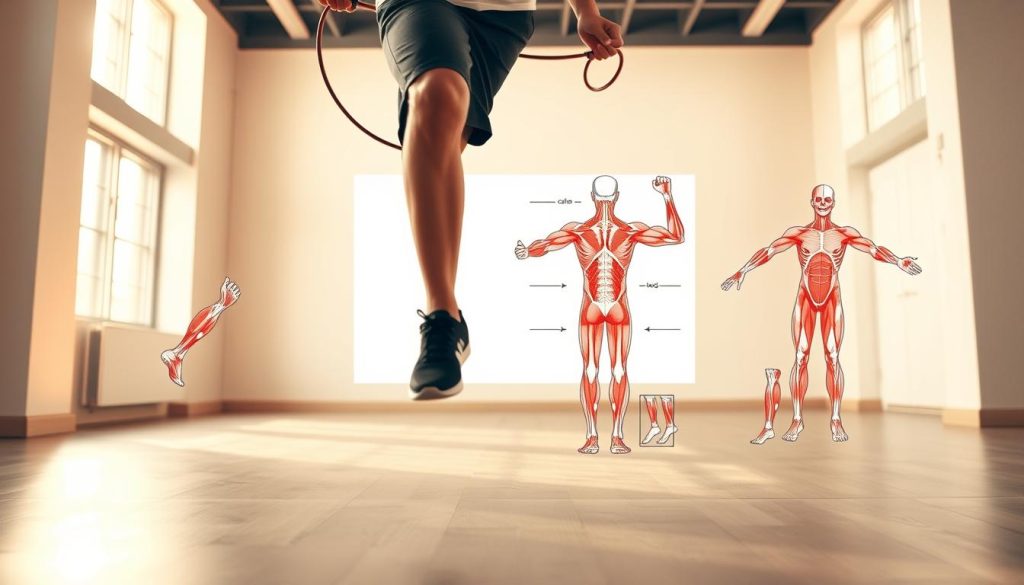
A single session activates big movers and small stabilizers so you gain power and control at once. A complete routine recruits calves, quads, hamstrings, glutes, core, forearms, biceps, triceps, shoulders, and back. That mix explains why short sessions feel so efficient.

Primary movers vs. stabilizers
Primary movers are the calves and the thigh/hip group that extend ankle, knee, and hip for every jump cycle.
Stabilizers include the core, scapular muscles, and the small forearm and wrist muscles that keep the path steady and landings soft.
How engagement changes with speed and rope weight
As speed rises, timing and reactive force increase, shifting more work to fast-twitch fibers and coordination demands.
- Heavier systems boost upper body and grip demands, stressing deltoids, rhomboids, and rotator cuff.
- Adjusting cadence or weight offers a simple training dial to favor power, endurance, or control.
- Single-leg and lateral patterns raise stabilizer recruitment without new equipment.
Calves: The Powerhouse Behind Every Jump
The lower leg does most of the heavy lifting during each rep, acting like a spring that stores and releases energy. The gastrocnemius and soleus drive ankle extension on every contact. Together they convert a brief ground strike into upward force and steady rhythm.
Gastrocnemius and soleus mechanics
The gastrocnemius provides the explosive push for faster efforts. The soleus supports repeated, small rebounds that keep cadence smooth. According to the American Council on Exercise, jumping rope improves connective tissue elasticity around these areas, which raises power output and lowers injury risk.
Technique cue: land on the balls of your feet
Land lightly on the balls of your feet, then lower the heels before the next push. This pattern spreads load across the Achilles and plantar structures and helps the ankle spring work efficiently.
- Calf stiffness equals better recoil and speed transfer to sprints and direction changes.
- Small tweaks — quiet landings and a slight knee bend — protect joints and preserve strength.
- If fatigue sets in, shorten sets, slow the cadence, or use a lighter rope until form resets.
Quads, Glutes, and Hamstrings: Lower-Body Strength and Shape
Your lower body supplies the push and the brake that make each rep efficient. These groups extend the hips and knees to create propulsion and then control descent for safe, repeatable effort.
Hip and knee extension is the core action for power. The quads and glutes drive takeoff while the hamstrings load and guide soft landings.
Progression matters. Moving to single-leg hops increases glute activation and challenges balance, forcing one leg to manage force and stability.
How this helps running and sprinting
Short ground contact trains plyometric efficiency. That improves stride stiffness, reactive strength, and sprint acceleration in runners.
- Your quads and glutes create the primary drive; hamstrings manage deceleration and joint control.
- Alternating high-knee patterns boost knee lift, posture, and rhythm at higher cadences.
- Rotate bilateral and single-leg drills to build balanced strength and endurance for other training days.
Coaching tip: If legs feel heavy, cut volume and focus on crisp mechanics. Use shorter, high-quality sets to build endurance and keep form clean.
Core: Transfer Power and Protect Your Back
Think of the midsection as the hub that moves force from the legs to the arms with minimal loss. Treat the move like a “jumping plank”: brace the transverse abdominis and keep a straight, rigid line. That alignment makes each rep more efficient and shields the lower back from repeated impact.
Bracing like a “jumping plank” for efficiency
A firm core stabilizes the spine so power from the legs transfers cleanly through the torso. Keep ribs stacked over hips and use a short, steady breath to hold tension without gripping the neck.
Oblique add-ons: side-to-side hops and rotational drills
Introduce side-to-side hops, boxer steps, and gentle rotations to cue the obliques and improve lateral control. These patterns train multi-directional strength and make transitions smoother in other sports.
- A strong core lets leg power pass through the upper body with less energy loss.
- Short cues — “tall posture, tight abs, soft feet” — help you keep form when tired.
- If you drift during a set, reset posture and shorten the interval to protect your back.
Practice tip: Between intervals, do a quick core reset for 10–15 seconds. Over weeks, this habit builds better control, cleaner landings, and greater overall strength for the jump rope and other exercises.
Shoulders and Back: Scapular Control and Upper-Body Stability
When the scapulae sit stable and down, the upper back becomes a steady platform for rhythmic turns. With solid form—shoulders quiet and scaps set—the deltoids, rhomboids, and rotator cuff work to steady the handle path. This keeps the neck and traps relaxed and reduces wasted motion during sets.
Deltoids, rhomboids, and rotator cuff under load
Delts guide the handles while the rotator cuff and rhomboids lock the shoulder joint. Clean scapular control keeps the path tight and cuts fatigue in longer intervals. Keep elbows close and drive the turn mainly from the wrists for efficient timing.
Why weighted ropes increase upper-body demand
Weighted options raise time-under-tension, especially in the rear delts and mid-back. Research in the Journal of Sports Rehabilitation found jump rope training can boost shoulder strength and help athletes transfer power to pressing and squatting lifts.
- Quiet shoulders with crisp wrists reduce neck strain.
- Weighted ropes add control work and build endurance in the upper back.
- If tension appears in the neck, reset posture or lower the weight and shorten sets.
- Alternate speeds to learn inertia control and gain confidence with heavier ropes.
Arms and Forearms: Grip, Wrist Strength, and Endurance
A quiet, controlled turn from the wrist builds grip endurance that carries over to heavy lifts and carries. The constant handle tension trains the finger flexors and forearm to hold under fatigue. That steady hold supports chin-ups, deadlifts, and farmer carries.
Isometric forearm loading for better lifts and carries
Small wrist circles, not big arm swings, keep the handle path consistent and shoulders relaxed. Strong wrists make the rope easier to control and cut energy leaks at higher speed.
- The steady grip trains finger flexors to sustain tension during longer sets.
- Isometric loading transfers to barbell holds, farmer’s carries, and grip-heavy exercises.
- If hands tire first, shorten intervals and refine smooth, economical turns before adding volume.
- Vary handle thickness or add light weight to build endurance without strain.
- Improved forearm strength also helps balance for single-leg or lateral patterns.
Performance and Health Benefits You Can Feel
Consistent, rhythmic practice brings measurable gains in endurance, power, and coordination. Short, focused sessions recruit nearly every major group and keep timing front and center. That makes each minute efficient for fitness and daily movement.
Endurance and coordination improve quickly. The steady cadence refines footwork and eye-hand timing, which translates to better agility and sport skills. Even brief warmups with a jump rope sharpen running and court performance.
Explosive power from fast-twitch recruitment
Crisp rebounds call on fast-twitch fibers, boosting sprint and jump ability. Short, intense sets train reactive strength that transfers to other lifts and drills.
Bone density, heart health, and metabolic advantages
“Ten to twenty brief impacts, done consistently, can support hip bone density over months.”
Controlled impact raises heart rate efficiently, improving cardiovascular markers and metabolic balance. Over weeks, this practice supports a healthier lean mass-to-fat ratio and better daily energy.
- Builds endurance while honing timing and rhythm.
- Boosts explosive power for sprints and plyometrics.
- Supports bone density and elevates heart rate with smart progression.
Form, Fit, and Flow: Technique and Rope Selection Tips
A clear stance, steady wrists, and soft landings form the fastest way to progress. Good setup saves energy and protects joints so you can train more often.
Posture and turn mechanics: Stand tall with chest lifted and core engaged. Hold handles at your sides and keep elbows tucked so wrists drive the spins. Keep shoulders quiet to avoid neck strain.
Posture, wrist-driven turns, and soft, rhythmic landings
Aim for light, rhythmic landings on the balls of your feet with knees slightly bent. Look ahead and jump only as high as needed to clear the rope. These small cues protect joints and conserve energy during longer sessions.
Finding the right rope length and when to go weighted
Check fit by standing on the midpoint; handles should reach about armpit to shoulder height. Start with a lighter rope to learn timing. Once coordination and rhythm are steady, test a modest weight.
“Tall posture, quiet shoulders, quick wrists, soft landings—every set, every time.”
- Lengthen the rope if it snags your shoes; shorten it if it drags the floor.
- Choose a surface with a bit of give to reduce impact and extend rope life.
- Integrate short rope workout blocks into your routine to build balance and confidence.
Progress safely: Add weight gradually so shoulders and grip adapt without sacrificing form. This is the best way to improve skill and protect your body.
Muscle-Toning Jump Rope Workouts and Variations
Use brief, intense intervals to concentrate effort on calf spring, midline bracing, and shoulder endurance without extra equipment.
Time-savvy intervals for calves, core, and shoulders
Try this practical 10-minute plan:
- 60s on / 30s off × 3 rounds, then rest 60s.
- 120s on, rest 60s.
- 30s on / 60s off, then 30s on / 30s off to finish.
Keep sets short and focused. Breathe steady and land softly to protect joints.
Targeted progressions: single-leg, high knees, and double-unders
Vary patterns to shift emphasis across hips, quads, and hamstrings while building coordination.
- Single-leg hops (10–20s per side) to boost glute work and balance.
- High knees for cadence, cardio, and core drive in quick bursts.
- Short double-under attempts to train explosive timing—keep reps low and quality high.
- Rotate footwork—boxer, lateral, ski—to hit different fibers and stay engaged.
Progress tip: Add one interval per week or raise pace slightly, but never at the cost of clean form. Finish with gentle spins and mobility for calves, hips, and shoulders.
Conclusion
A few focused minutes each day add up to measurable improvements in body composition and fitness. Regular jumping rope practice can shift lean mass versus fat in as little as 12 weeks when you progress sensibly and keep technique tidy.
Prioritize tall posture, quick wrists, and soft landings. Those cues cut risk and let you enjoy the benefits while building power, balance, and core control.
Mix short intervals with skill practice. Pair these sessions with simple exercises like squats, planks, or carries to round out strength and protect your back.
Keep it portable and consistent: five to ten focused minutes some days can reset your energy and deliver steady endurance and health benefits over time.